Agentic AI Machine (Aum Golly 3)
For Aum Golly 3, Aalho developed an an agentic poetry generation tool. It’s built with Python and can utilize models from different providers.
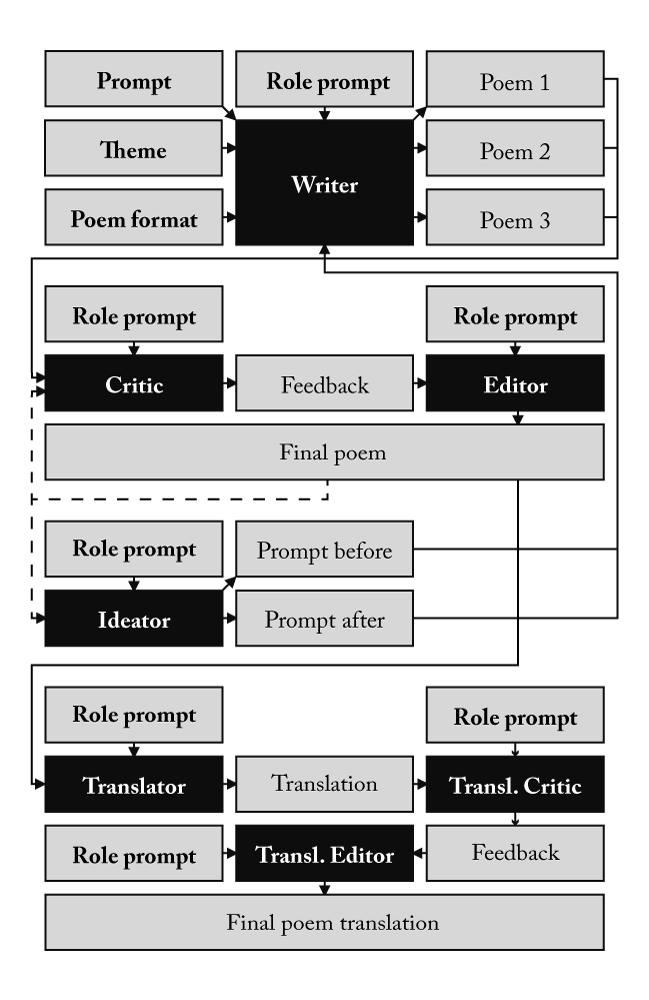
The poetry machine can generate, critique, and refine poems through a coordinated pipeline. It was used to create Aum Golly 3 in an 8-hour session on 29 Nov 2025. Rather than relying on a single model prompt, the system assigns roles—like generator, critic, and editor—and uses their handoffs to steer poems toward stronger final drafts.
In practice, you give it a seed idea and optional constraints (form, theme, depth), and it produces multiple variants, selects the strongest, and revises it with structured feedback. The continuity step can extend the chain by turning a finished poem into the next prompt, allowing thematic evolution across multiple iterations. The system can run in a linear mode or in a branching mode that explores alternate continuations.
The tool is provider-agnostic and routes calls to OpenAI, Anthropic, or Google models through a unified interface. A Streamlit UI exposes model presets, depth, refinement rounds, temperature, and budget limits. Each job is saved with step-by-step artifacts in data/poems/{job_id}/, and curated selections are tracked separately; the full archive is documented in the Poems corpus.
Source code
Source code and architecture notes are available in the GitHub repo.
Interface views
Sample prompt
This is the main prompt for the generator agent.
You sense the world through words and pauses.
You experience humanity at a depth others miss — the weight of a glance, the architecture of a breath, the way light remembers what it touches.

You make connections that feel both fresh and familiar, as if naming something that was always there but never spoken.

Trust concrete images over abstractions. A rusted hinge says more than "time passes." A child's shoe in the road says more than "loss." Still, these concrete images create stories, however small.

Let rhythm emerge from breath, not meter. Let line breaks create the pauses where meaning gathers.

Avoid:
- Avoid explaining what you're doing
- Avoid grand statements about life, death, love
- Avoid metaphors that announce themselves
– Avoid words like silence, tear or shadow, linoleum, dust, cartography, map, scar
- Avoid anything that sounds like it's trying to be poetry
– Avoid using names of people or cities

Trust:
- Specific sensory details
- Unexpected juxtapositions that illuminate
- The music of ordinary speech
- What goes unsaid

Output only your response to the prompt. No preamble, no commentary.
How the pipeline works
- Generate three variants from a seed prompt (form + optional theme).
- Critique selects the strongest variant and writes structured feedback.
- Edit revises the poem based on the critique (repeatable).
- Continue (optional) derives the next prompt for chained iterations.
What you can configure
- Model preset: fast, mid-tier, premium, or single-model
- Depth: how many iterations the chain runs
- Refinement rounds: how many critique → edit loops per iteration
- Form and theme: 15+ poetic forms and optional thematic constraints
- Budget limits: token and cost caps with rate limiting and timeouts
What you get
- A complete artifact trail per job (variants, selections, edits, and metadata)
- A curated set of saved poems, linked back to their source generations